

The announcement of a ceasefire in Gaza was supposed to signal relief after weeks of relentless violence, offering civilians a brief chance to breathe. Historically, ceasefires are framed as moments of hopepauses meant to protect lives and allow humanitarian aid to reach those trapped in conflict zones. However, in Gaza, that hope was quickly overshadowed by reality. Within hours of the ceasefire beginning, residents reported unrelenting bomb sounds, shaking homes and nerves alike. The promise of peace collapsed under the echo of explosions, raising urgent questions about the credibility of ceasefire declarations in the Gaza conflict.
For civilians on the ground, the ceasefire did not translate into safety. Instead of silence, the night sky remained loud with the sounds of airstrikes, shelling, and military drones, reinforcing a deep sense of betrayal. The contradiction between official statements and lived reality highlights a recurring pattern in the regionwhere a Gaza ceasefire exists on paper but fails in practice. These continued bomb sounds are not just military actions; they represent a psychological assault on a population already exhausted by war, displacement, and loss.
Globally, this moment matters because it exposes the fragile nature of modern ceasefires and the lack of enforcement mechanisms behind them. When bombings in Gaza after the ceasefire continue unchecked, they erode international trust and normalize violations of humanitarian commitments. The persistence of violence despite diplomatic announcements forces the world to confront an uncomfortable truth: without accountability, a ceasefire is merely a word, not a shield. In Gaza, the sky did not fall silent; it spoke louder than politics.
Understanding the Ceasefire Agreement
The declared ceasefire in Gaza was presented as a diplomatic breakthrough aimed at halting active hostilities and reducing civilian suffering. International mediators framed the agreement as a temporary pause designed to stop military operations, enable humanitarian aid, and prevent further escalation in the Gaza conflict. On paper, the ceasefire appeared comprehensive, promising restraint from all sides and signaling a move toward stability.
However, the reality surrounding the Gaza ceasefire agreement quickly exposed its fragility. A lack of transparency, vague language, and the absence of strict enforcement mechanisms weakened its effectiveness from the start. For civilians, understanding what the ceasefire actually meant became difficult, especially when bomb sounds after the ceasefire contradicted official claims. This gap between agreement and execution lies at the heart of why ceasefires in Gaza repeatedly fail to deliver peace.
What the Ceasefire Officially Promised
Officially, the ceasefire agreement in Gaza pledged an immediate halt to airstrikes, ground assaults, and other forms of direct military engagement. The goal was to reduce casualties and create space for emergency relief operations, including medical aid, food supplies, and infrastructure repair. International actors emphasized that the ceasefire would protect Gaza civilians and prevent further destruction.
Yet, the language used in the agreement left room for interpretation. Terms such as “defensive actions” and “security responses” were not clearly defined, allowing continued military activity after the ceasefire under different justifications. This ambiguity weakened the promise of safety and allowed violations to occur without clear accountability, undermining the ceasefire’s core purpose.
Who Brokered the Ceasefire and Why It Matters
The Gaza ceasefire was brokered through international mediation involving regional and global powers seeking to de-escalate tensions. These mediators aimed to prevent the conflict from expanding beyond Gaza and destabilizing the wider region. Their involvement was critical in pushing both sides toward agreement, at least diplomatically.
However, mediators lacked enforcement authority. Without binding consequences for ceasefire violations in Gaza, the agreement relied heavily on goodwill rather than obligation. This limitation meant that when explosions were reported after the ceasefire, there was no immediate mechanism to stop them, highlighting a recurring weakness in internationally brokered ceasefires.
Why Ceasefire Terms Often Fail on the Ground
One major reason the Gaza ceasefire agreement struggled is the disconnect between political negotiations and realities on the ground. Military operations do not always stop instantly, especially in densely populated conflict zones like Gaza, where airspace activity and surveillance continue even during declared pauses.
Additionally, the absence of independent monitoring allows post-ceasefire bombings to go unaddressed rather than disputed. For civilians, this failure translates into fear and uncertainty, as a ceasefire that cannot guarantee silence offers little protection. The continued bomb sounds in Gaza after the ceasefire reveal how fragile and incomplete such agreements often are.
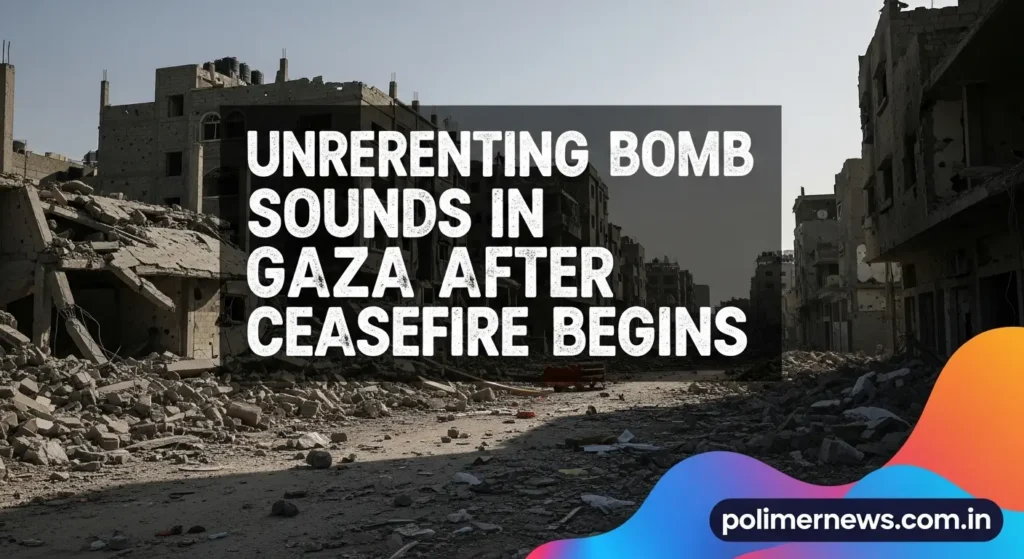
Bomb Sounds After Ceasefire: What Was Heard and Where
Despite the official declaration of a Gaza ceasefire, reports of continuous bomb sounds began surfacing almost immediately from multiple areas across the Strip. Residents described loud explosions, aerial activity, and shockwaves that rattled buildings, making it clear that the ceasefire did not bring the expected silence. These sounds were not isolated incidents but recurring disturbances that challenged claims of a complete halt in hostilities.
The persistence of bombings in Gaza after the ceasefire highlights a critical disconnect between diplomatic announcements and on-ground realities. For civilians, the sound of explosions is not just noise; it is a warning of danger, displacement, and potential death. The fact that such sounds continued after a ceasefire raises serious concerns about compliance, monitoring, and the overall credibility of ceasefire agreements in the Gaza conflict.
Areas in Gaza Reporting Explosions
Multiple neighborhoods across Gaza reported explosion sounds after the ceasefire, including densely populated residential areas. These reports came from locations already heavily damaged by earlier attacks, intensifying fear among civilians who had hoped the ceasefire would allow them to rest or return home safely.
The widespread nature of these reports suggests that the post-ceasefire bomb sounds were not limited to a single incident or location. Instead, they point toward ongoing military activity that contradicts ceasefire commitments. For SEO and documentation purposes, this pattern strengthens claims of ceasefire violations in Gaza and highlights the scale of the issue.
Nature of the Sounds: Airstrikes, Shelling, and Drones
Witnesses described different types of bomb sounds in Gaza, including loud blasts consistent with airstrikes, distant but heavy artillery shelling, and the constant buzzing of military drones overhead. Each sound carries a distinct psychological weight, signaling potential danger even when the immediate impact is unclear.
The presence of drones during a ceasefire period is particularly alarming, as it suggests continued surveillance and readiness for attack. These sounds reinforce the idea that while large-scale offensives may pause, military pressure after the ceasefire often continues in other forms, keeping civilians in a constant state of fear.
Timing of the Explosions After Ceasefire Began
One of the most troubling aspects of the Gaza ceasefire violations is how soon the explosions were reported. In several cases, bomb sounds were heard within hours of the ceasefire’s official start, leaving little doubt about the agreement’s fragility.
This timing undermines international confidence and raises questions about whether the ceasefire was ever fully implemented. When explosions in Gaza after the ceasefire occur so quickly, they suggest either a lack of coordination or a deliberate disregard for the agreementboth of which deepen civilian suffering and prolong instability.
Voices from Gaza: Civilian Experiences and Psychological Impact
The ongoing conflict in Gaza has left civilians trapped in a constant cycle of fear and uncertainty, with the unrelenting bombings shattering their daily lives. Families struggle to maintain a sense of normalcy amid collapsing infrastructure, scarcity of essentials, and the ever-present threat of violence. Many residents describe the constant sound of explosions as a haunting backdrop to their lives, impacting children’s development and adults’ mental well-being. These experiences are not isolated; they reflect a collective trauma, one that is deepened by the destruction of homes, schools, and hospitals. The psychological scars are as severe as the physical devastation, creating long-term challenges for recovery and social stability.
In addition to the immediate danger, the psychological impact of sustained conflict manifests in widespread anxiety, depression, and post-traumatic stress disorder (PTSD). Civilians recount nights spent in bomb shelters, fearing for their lives while witnessing neighbors lose loved ones. For many, the emotional toll is compounded by limited access to mental health services, forcing families to cope with trauma largely on their own. The resilience of the people of Gaza is remarkable, yet the invisible wounds of this war continue to grow, emphasizing the urgent need for humanitarian and psychological support.
Daily Life Amid Conflict
Daily life in Gaza has been profoundly disrupted by ongoing hostilities. Children are forced to abandon schools, families scramble for necessities, and many live under constant curfews or restrictions on movement. The uncertainty of each day weighs heavily on residents, making even simple tasks, like grocery shopping or attending school, acts of courage. Civilians often rely on informal networks of support within their communities, demonstrating resilience but also highlighting the fragility of daily existence under siege.
The destruction of infrastructure further exacerbates daily struggles. Roads, electricity, and water systems are frequently damaged, leaving families in precarious conditions. Access to healthcare becomes sporadic, and hospitals often operate under severe resource constraints. The psychological burden of unpredictability merges with the physical challenges, creating an environment where fear dominates. Yet, despite these hardships, many residents cling to routine as a means of survival, showing remarkable human endurance and adaptability in the face of relentless adversity.
Psychological Trauma and Emotional Toll
The psychological impact on civilians in Gaza is immense and multifaceted, affecting both adults and children. Exposure to constant bombardment leads to chronic stress, insomnia, and anxiety disorders. Children, in particular, exhibit signs of trauma, including nightmares, aggression, and difficulty concentrating. Families live with perpetual fear, unsure if they will have shelter, food, or safety. Mental health professionals warn that these conditions may result in generational trauma, shaping the emotional well-being of entire communities for years.
Adults, meanwhile, face emotional exhaustion and hopelessness, struggling to protect their families while dealing with loss and uncertainty. Parents often feel helpless witnessing the trauma their children endure, compounding their own stress. Limited access to psychological support services worsens the situation, leaving many to cope through community solidarity or personal resilience. The cumulative effect of physical danger, emotional strain, and disrupted social networks paints a stark picture of the human cost of conflict, emphasizing the need for urgent humanitarian interventions.
Media Coverage vs. Ground Reality
Media plays a critical role in shaping global perceptions of the Gaza conflict, yet there is often a significant gap between coverage and the lived experiences of civilians. While news outlets focus on major bombings or political statements, the daily struggles, emotional trauma, and resilience of ordinary people are frequently underreported. The selective reporting can create a skewed narrative, leaving international audiences with an incomplete or superficial understanding of the humanitarian crisis.
Moreover, the nature of modern mediawith short attention spans, viral headlines, and political biasesmeans that contextual nuances are often lost. Civilians’ stories, personal losses, and coping strategies rarely make it to the headlines, despite their centrality to understanding the true impact of the conflict. Bridging this gap is essential for raising awareness, mobilizing aid, and holding decision-makers accountable for the human consequences of prolonged hostilities.
Discrepancy in Reporting
There is a stark contrast between what journalists report and what civilians experience on the ground. Many news outlets emphasize military operations, casualty numbers, or political statements, while neglecting the everyday hardships faced by families. Civilians often describe their suffering as invisible to the world, from disrupted education and destroyed homes to the psychological toll of constant bombardment.
This discrepancy can distort public perception, affecting international response and policy decisions. Misrepresentation or underreporting of the human dimension risks reducing real human suffering to statistics, instead of highlighting urgent humanitarian needs and long-term consequences. Accurate reporting is therefore critical for empathy-driven interventions and global awareness.
Social Media and Civilian Voices
Social media has emerged as a double-edged sword in the Gaza conflict. On one hand, it allows civilians to share firsthand experiences, giving the world a window into daily life amid bombings. Videos, personal accounts, and live updates can amplify stories that traditional media overlooks, creating a more comprehensive picture of the crisis.
On the other hand, social media can spread misinformation, exaggerations, or propaganda, making it challenging to discern verified facts. Despite these risks, platforms like Twitter, Instagram, and TikTok have become vital tools for activists and journalists trying to highlight the human reality behind headlines, bridging some of the gaps left by conventional media.
Who Is Responsible? Claims, Denials, and Counterclaims
The ongoing conflict in Gaza has sparked intense debate over responsibility for the violence, with multiple parties issuing claims, denials, and counterclaims. Governments, armed groups, and international organizations often present conflicting narratives, each emphasizing their perspective and blaming the other side. These competing narratives make it challenging for the global audience to discern accountability, while civilians continue to bear the brunt of destruction. The question of responsibility is further complicated by the political, historical, and regional dimensions of the conflict, which shape how events are reported, interpreted, and acted upon.
Adding to this complexity, accusations and denials are frequently amplified through media and political channels, creating a fog of information. Civilians on the ground often experience a stark contrast between these claims and their lived reality, with little clarity on how justice or reparations will be achieved. Understanding the dynamics of responsibility requires not only examining the actions of armed groups and governments but also acknowledging the broader geopolitical context that perpetuates cycles of violence.
Government Statements and Blame
Governments involved in the conflict often issue formal statements assigning blame to the opposing side, citing alleged provocations, security threats, or violations of international law. These declarations serve political purposes, reinforcing domestic support or justifying military actions. However, such claims are frequently contested, and independent verification can be difficult due to restricted access to conflict zones.
The focus on official blame often overshadows civilian suffering, as the debate centers on political narratives rather than humanitarian concerns. Civilians are left navigating the consequences of actions over which they have no control, while global attention is drawn more to accusations than relief efforts, highlighting a disconnect between political responsibility and human impact.
Counterclaims and International Reactions
Counterclaims emerge from armed groups, local authorities, and international actors, each seeking to challenge or refute the narratives presented by opposing parties. These conflicting accounts contribute to confusion over who is responsible for specific attacks, casualties, or humanitarian crises. Independent investigations and reports from international organizations attempt to clarify accountability, but access restrictions and political interference often limit their effectiveness.
International reactions, including condemnations, calls for ceasefires, or proposed sanctions, reflect the global community’s struggle to assign responsibility fairly and effectively. While these measures can pressure conflicting parties, they often fail to address the immediate needs of civilians, leaving residents to cope with ongoing insecurity, trauma, and the destruction of their communities.
The Meaning of a Ceasefire for Civilians
For civilians in Gaza, a ceasefire is more than just a political agreement; it represents a fragile hope for safety, relief, and a brief respite from constant bombardment. However, the reality is often more complex. Even when a ceasefire is declared, the threat of renewed violence remains, and many families live with uncertainty, unable to fully relax or resume normal life. The psychological relief may be immediate, but economic hardships, destroyed infrastructure, and emotional trauma persist long after the bombs stop.
Ceasefires are also symbolic gestures that signal the possibility of dialogue and diplomacy, offering temporary protection and access for humanitarian aid. For children, even short periods without explosions allow moments of play, schooling, and social interaction critical for mental health. Yet, civilians remain acutely aware that these pauses can be temporary and unpredictable, highlighting the precariousness of life in conflict zones.
Immediate Relief and Safety
Ceasefires provide much-needed immediate relief to families living under constant bombardment. Hospitals can operate more safely, aid convoys can deliver essential supplies, and children may return to school or play outdoors. These pauses allow families to attend to urgent needs, repair damaged homes, or visit relatives without fear of sudden attacks.
However, even during ceasefires, uncertainty and fear remain. Many families hesitate to leave shelters completely, fearing sudden violations or escalations. For civilians, safety is a relative term, and the psychological toll of living in a fragile truce is profound. The respite, while significant, is often insufficient to undo the cumulative trauma of prolonged conflict.
Humanitarian Access and Long-Term Implications
Ceasefires are critical for humanitarian operations, allowing aid organizations to deliver food, medicine, and water to populations in desperate need. Access to these resources can save lives, prevent disease, and reduce suffering, particularly among vulnerable groups like children, the elderly, and the sick.
Beyond immediate aid, ceasefires can set the stage for long-term recovery efforts. Rebuilding damaged homes, restoring utilities, and providing psychological support depend on sustained periods of calm. However, without durable political solutions, ceasefires remain temporary measures, offering only short-term relief while the underlying causes of the conflict persist. For civilians, this underscores the importance of lasting peace over intermittent pauses.
History Repeating: Previous Ceasefires That Failed Gaza
The history of ceasefires in Gaza demonstrates a repeated cycle of hope and disappointment for civilians. Past agreements often promised temporary relief and a pause in hostilities but frequently collapsed within days or weeks, leaving residents once again exposed to bombardments, displacement, and trauma. These repeated failures have fostered a sense of skepticism and anxiety among Gaza’s population, who have learned to brace for violence even when ceasefires are announced.
The failure of previous ceasefires is rooted in a combination of political disagreements, mistrust between parties, and inadequate enforcement mechanisms. While ceasefires provide a temporary lull in fighting, they rarely address the structural causes of the conflict, leaving civilians to bear the ongoing human cost. The cycle of short-lived agreements and renewed attacks contributes to long-term psychological and social damage, as communities repeatedly rebuild their lives only to see them shattered again.
Short-Lived Ceasefires and Civilian Disillusionment
Many past ceasefires in Gaza lasted only days, offering brief windows of relief before violence resumed. Civilians often returned to damaged homes, disrupted schools, and destroyed infrastructure, only to face renewed bombings. This cycle has fostered a deep sense of disillusionment, as families struggle to reconcile the promises of peace with the reality on the ground.
The repeated breakdown of ceasefires also erodes trust in both local authorities and international mediators. Civilians become cautious, often hesitant to leave shelters or resume normal activities, understanding that safety is temporary and fragile. This disillusionment compounds the psychological toll of prolonged conflict, making hope and recovery more difficult to sustain.
Political Obstacles and Enforcement Challenges
The collapse of ceasefires is often linked to political disagreements between parties, lack of commitment, and the absence of robust enforcement mechanisms. Disputes over borders, military operations, and control of territory frequently lead to violations, undermining the intent of temporary peace agreements.
International mediators face challenges in ensuring compliance and monitoring ceasefires, particularly in densely populated areas with limited access. Without reliable enforcement and accountability, ceasefires remain symbolic gestures rather than meaningful protections. For civilians, this reality underscores the urgent need for durable political solutions rather than temporary pauses in violence.
What Comes Next? Uncertain Peace and Ongoing Fear
For civilians in Gaza, even after a ceasefire, the future remains uncertain and fraught with anxiety. While pauses in fighting can bring temporary relief, the persistent threat of renewed violence means families live in a state of chronic fear. The unpredictability of the situation makes planning for the future nearly impossible, as homes, schools, and businesses may again be destroyed without warning. This uncertainty affects every aspect of life, from children’s education to access to healthcare, leaving civilians caught in a cycle of survival rather than recovery.
The sense of uncertainty is amplified by political instability and ongoing regional tensions, which can quickly reignite hostilities. For residents, even brief periods of calm are overshadowed by memories of previous failed ceasefires and the realization that security is fragile. The psychological toll of living with this constant unpredictability cannot be overstated, as anxiety, depression, and post-traumatic stress are pervasive among both adults and children.
Living in Fear Despite Ceasefires
Ceasefires, while providing temporary relief, often fail to eliminate the underlying threats. Civilians continue to hear distant explosions, navigate damaged infrastructure, and live with the memory of lost loved ones. Parents worry about their children’s safety, and communities struggle to rebuild while fearing sudden escalations.
This persistent fear has a cumulative psychological impact, resulting in chronic stress, insomnia, and heightened vigilance. Even when daily life seems to return to normal, the shadow of violence lingers, shaping behaviors and choices. For many, peace feels conditional and fleeting, rather than a lasting state.
Preparing for an Unpredictable Future
Communities in Gaza have adapted to uncertainty through resilience and resourcefulness, often developing informal support networks and coping mechanisms. Families prioritize immediate survival, such as securing food, water, and shelter, while attempting to maintain routines for children.
Yet, the unpredictability of conflict makes long-term recovery and development difficult. Efforts to rebuild infrastructure, restore schools, and provide healthcare are constantly threatened by renewed hostilities. For civilians, hope is balanced by fear, creating a complex reality where peace is both desired and precarious, and the next chapter of the conflict remains unknown.
Frequently Asked Questions (FAQs) About Gaza Conflict and Ceasefires
What is a ceasefire in the context of the Gaza conflict?
A ceasefire is a temporary agreement between conflicting parties to halt military actions. In Gaza, ceasefires are intended to reduce violence, allow humanitarian aid, and provide civilians with brief periods of safety. However, these agreements often fail to address underlying political disputes, making them temporary and fragile.
Why do ceasefires in Gaza frequently fail?
Ceasefires often fail due to political disagreements, lack of enforcement, and mutual mistrust between conflicting parties. Without proper monitoring and accountability, violations are common, leading to renewed violence and civilian suffering.
How do civilians in Gaza cope with constant bombardment?
Civilians rely on resilience, community support, and informal coping mechanisms. Families often use shelters, share resources, maintain routines for children, and engage in cultural or religious practices to manage stress and trauma.
What is the psychological impact of prolonged conflict on Gaza residents?
Residents experience chronic stress, anxiety, depression, and post-traumatic stress disorder (PTSD). Children are particularly vulnerable, showing signs of nightmares, aggression, and difficulty concentrating, while adults face emotional exhaustion and uncertainty.
How does media coverage differ from ground reality in Gaza?
Traditional media often focuses on political developments and casualty numbers, while underreporting civilians’ day-to-day struggles. Social media allows firsthand accounts, but misinformation can spread, making it challenging to capture the full reality.
What humanitarian challenges do civilians face during and after conflicts?
Civilians contend with destroyed infrastructure, lack of electricity, clean water, medicine, and food shortages. Hospitals are overwhelmed, and access to basic services is limited, exacerbating suffering even during ceasefires.
What role does the international community play in Gaza?
International organizations provide humanitarian aid, monitoring, and diplomatic mediation, but political complexities and restricted access limit the effectiveness of these interventions in ensuring lasting peace.
Can a long-term peace be achieved in Gaza?
Long-term peace requires sustainable political solutions, accountability, and humanitarian support. Temporary ceasefires alone are insufficient, as they do not address the root causes of the conflict or guarantee safety for civilians.
Conclusion:
The ongoing conflict in Gaza underscores the enormous human cost of war, where civilians endure daily fear, destruction, and psychological trauma. While ceasefires offer temporary relief, they are often fragile, failing to provide lasting security or address the deep-rooted political and social issues fueling the violence. Families continue to navigate destroyed homes, disrupted schools, and overwhelmed hospitals, highlighting the urgent need for sustainable humanitarian and political solutions.
Voices from Gaza reveal the resilience, courage, and solidarity of communities striving to survive amidst chaos. Yet, the repeated cycle of temporary peace followed by renewed bombardments has created long-term emotional and social scars, especially among children. Accurate media coverage, international aid, and diplomatic efforts play critical roles, but real progress depends on durable ceasefires, accountability, and a comprehensive approach to rebuilding lives.
Ultimately, the story of Gaza is a stark reminder that the impact of conflict extends far beyond headlines, touching every aspect of daily life. Only through global awareness, coordinated humanitarian support, and meaningful political solutions can civilians hope for lasting peace, safety, and the restoration of normalcy in a region long marked by violence and uncertainty.


